
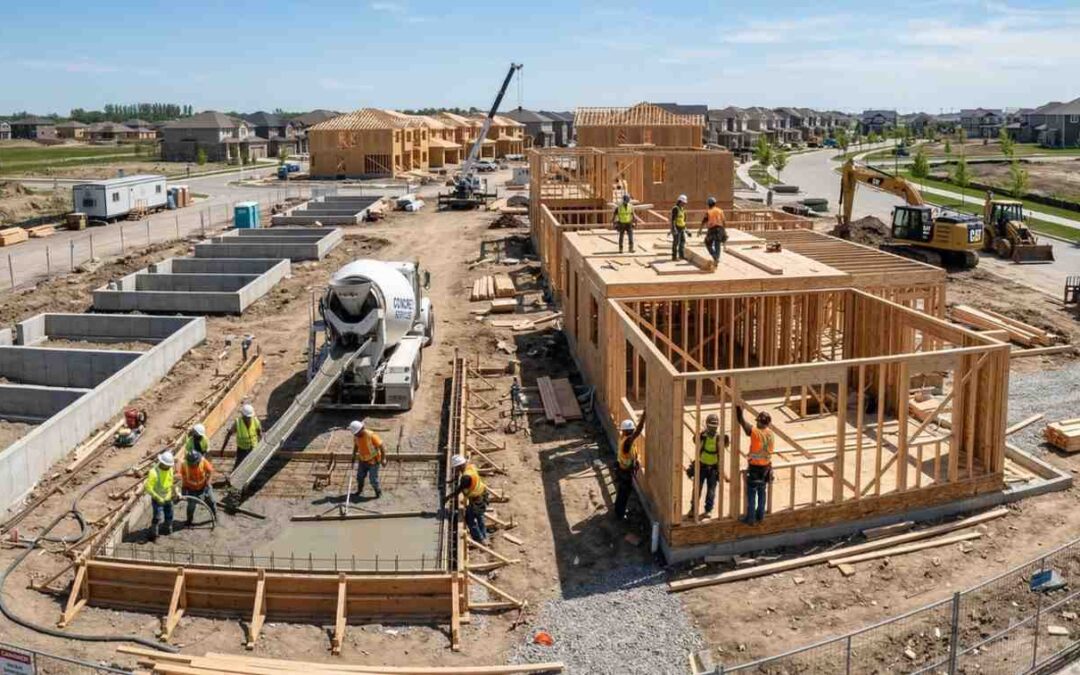
The construction industry already needs hundreds of thousands of additional workers just to meet current demand levels, and mortgage rates above 6% show no sign of releasing pent-up housing supply quickly enough to change that math. For construction executives, the practical question is not when conditions will improve. It is how to staff the projects already on the table before the window quietly closes.
Which Roles to Hire First
Not every vacancy carries the same urgency. Some create cascading timeline failures; others absorb without breaking the project schedule. The hiring sequence matters as much as the hiring decision itself. The six roles below are field-execution focused. Estimators and cost engineers, roles that carry their own acute shortage and direct profitability risk, sit outside this sequence but deserve separate attention for any builder managing bid volume alongside production.
Carpenters and Framing Crews
Framing crews establish the structural shell and set the production pace for every trade that follows. Nothing moves until the frame is up. A delay here ripples through drywall, mechanicals, and finishes simultaneously, compressing the entire delivery schedule.
Concrete Workers
Concrete workers control foundation and flatwork timelines. Their availability determines when a site can open for vertical construction. When they are short, every subsequent phase waits, and that delay cannot be recovered without adding cost or compressing later trades.
Equipment Operators
Equipment operators enable site prep, grading, and earthwork. Without them, a site does not open. This is the first role that has to be in place, and it is consistently one of the hardest to source quickly in tight regional markets.
MEP Rough-In Crews
Mechanical, electrical, and plumbing rough-in crews control inspection sequencing. Their schedule directly determines when homes reach drywall, then finish, and then close out. A shortage in any one of these three trades creates a bottleneck that holds up entire phases of a production schedule simultaneously.
Superintendents
Superintendent recruitment is consistently underestimated. These roles rarely appear in labor shortage headlines alongside craft trades, but their absence creates coordination failures across every trade on site. A superintendent manages multiple subcontractor relationships, enforces schedules, and holds quality without constant senior intervention. Experienced superintendents are rarely searching actively, which makes this one of the slowest roles to fill through standard outreach and one of the most disruptive to leave open during a growth phase.
Project Managers
Project managers bridge field execution and ownership expectations across budgets, timelines, and client communication. When this role goes unfilled during a growth phase, schedule slippage and cost overruns accumulate without anyone in a position to catch them early. The result is future work lost with buyers, lenders, and trade partners who experienced the breakdown directly.
The Labor Constraints Shaping Every Hiring Decision
The roles above are hard to fill. The workforce supplying them has been shrinking for years. The workforce gap in residential construction shows up daily in delayed project starts, lost bids, and compressed margins.
According to the Associated Builders and Contractors, the construction industry needs between 349,000 and 500,000 additional workers in 2026 to meet current demand. Several compounding forces are driving that gap:
- Retirements are accelerating. Experienced trades workers are exiting the workforce faster than new entrants are replacing them. The median age of a construction worker in the U.S. is now in the mid-40s, several years older than the national workforce average, and the gap is widening.
- The youth pipeline remains thin. Trade school and apprenticeship enrollment have not recovered at a pace that closes the demographic deficit.
- According to the Associated Builders and Contractors, 94% of contractors report difficulty filling open positions. This spans every market, not just high-activity regions.
The Financial Cost of Vacant Roles
Most workforce discussions stop at delays. The financial exposure runs deeper.
A vacant craft role costs money. Project starts get pushed, extending carrying costs on land and construction financing. Interest accrues on lots that should be producing closings. Build cycles lengthen, compressing margins on fixed-price contracts. In markets where buyer patience is thin, extended timelines increase the risk of cancellations.
According to Dodge Construction Network, schedule delays tied to staffing gaps are adding weeks to build cycles on single-family projects in many cases. For a firm closing 20 to 40 homes per year, that impact compounds across every project in the pipeline simultaneously.
What the 2026 Housing Starts Forecast Tells Builders About Hiring
Understanding where starts are headed matters not as a general market signal, but as a direct input to hiring decisions. The pace and mix of construction activity in 2026 determines which roles become urgent, which regions face the tightest labor pressure, and how much runway builders have before market conditions shift the hiring environment against them.
Industry forecasts broadly project housing starts in the 1.3 to 1.4 million-unit range for 2026, a figure that most analysts expect to remain relatively flat compared to 2025. That headline number breaks down in ways that matter for workforce planning:
- Single-family production continues to lag. Persistently high mortgage rates are suppressing buyer demand, which keeps single-family starts below the levels that would trigger aggressive builder scaling. For builders operating in this segment, the practical implication is a stable but unpressured production environment: enough volume to justify filling key roles now, not enough to force it urgently until rates move.
- Multi-family has pulled back from its 2023-2024 peak. Oversupply in several metros, combined with tightened construction financing, is pushing most projections toward stabilization rather than growth through 2027. Builders with exposure to multifamily will see flatter pipelines, making workforce efficiency more important than headcount expansion.
- Regional starts diverge significantly. High-growth Sunbelt markets, including Texas, Florida, Arizona, and North Carolina, are carrying activity levels well above the national average. Builders in those states are not operating in a flat market. They are competing for labor in conditions that more closely resemble a boom.
The flat national forecast creates a specific window for hiring. In peak-cycle conditions, every firm tries to staff simultaneously, compressing timelines and driving up compensation. A stable market reduces that synchronized pressure and gives builders space to recruit deliberately rather than reactively. That window closes the moment rate stabilization or renewed demand triggers a production ramp-up, and staffing cannot respond at the same speed as volume can shift.
The Regional Starts Gap Changes Which Roles to Prioritize
Nationally flat starts do not apply evenly. Builders operating in high-growth states face a materially different hiring environment from those in markets where activity has cooled.
In states like Texas, Florida, Arizona, and North Carolina, the combination of elevated starts, infrastructure competition, and tight subcontractor capacity makes equipment operators, framing crews, and concrete workers the most constrained roles. These trades are being absorbed by commercial, infrastructure, and residential projects simultaneously. In slower-growth markets, the constraint tends to sit higher in the org chart. Superintendents and project managers are harder to attract in those regions, where experienced candidates face less competitive pressure to consider a move.
Knowing where starts are strongest is not just useful market intelligence. It directly shapes which roles a builder should prioritize filling first, and where compensation and speed-to-hire need to be most aggressive.
Where the Workforce Gap Is Hardest to Close
Labor constraints in homebuilding are not uniform. High-growth states face the most acute pressure, driven by dynamics that are operationally distinct from those in slower-growth markets.
States including Texas, Florida, Arizona, and North Carolina are seeing concentrated shortages driven by compounding factors:
- Wage escalation. Tight labor markets in these states push construction worker compensation higher, increasing hiring costs and making retention harder for builders without competitive pay structures.
- Infrastructure competition. Federal infrastructure spending pulls skilled trades workers toward public projects, shrinking the pool available to residential builders.
- Crew allocation pressure. The most capable subcontractor firms in high-growth areas are increasingly selective about which builders they commit to, favoring those with established track records over new relationships.
Builders scaling operations in these states compete with infrastructure contractors and commercial builders simultaneously, not just other homebuilders.
Read More: Hard-to-Fill Construction Roles and How to Recruit for Them
Recruitment Approaches That Actually Work
Filling the roles above requires more than posting an opening. The strategies that consistently produce results in a constrained labor market operate differently from standard hiring practices, and builders who understand that distinction staff more quickly and effectively than those who do not.
Competing for Candidates in a Tight Labor Market
Leverage sits with candidates, and compensation structures need to reflect that reality. Experienced field leaders and skilled trades workers are rarely active job seekers. Firms reach them through professional networks and specialized outreach, not job boards.
What helps advance offers:
- Signing bonuses and milestone incentives tied to project completion rather than arbitrary time thresholds
- Flexible scheduling that acknowledges the physical demands of trades work
- Advancement pathways from craft roles into lead, foreman, and superintendent positions are particularly important for attracting younger workers evaluating a long-term construction career
Leveraging Subcontractor Relationships for Production Capacity
Most homebuilders focus workforce planning on direct hires and overlook the production exposure created by subcontractor shortages.
Many subcontractors allocate their best crews to builders who offer predictable project pipelines and reliable payment practices. That allocation decision happens before the bid goes out. Builders who maintain strong trade partner relationships (consistent payment, clear scope communication, and advance scheduling visibility) secure capacity ahead of demand spikes. Builders without those relationships get what is left.
In tight markets, subcontractor access is as operationally significant as direct headcount.
Building a Workforce Pipeline That Outlasts 2026
Homebuilders who rely entirely on the open market for every hire will face recurring staffing pressure with no structural relief. The demographic trends driving the current gap are a decade-long issue, not a cyclical one.
Forward-looking builders are investing in:
- Trade school partnerships that build brand recognition with students before they enter the workforce
- Apprenticeship programs that develop craft workers in-house rather than competing exclusively for experienced candidates
- Veteran recruitment initiatives that reach a workforce segment with transferable discipline and technical skills
These programs take years to produce results, but create a hiring pipeline that reduces dependence on a competitive open market for every role.
Read More: How Construction Recruiters Are Supporting Disaster-Resilient Infrastructure Projects
Engaging Executive Search Before Vacancies Become Urgent
Superintendent, project manager, and senior craft leadership candidates are not browsing job listings. Firms that wait until an urgent vacancy appears to begin a search add months to the process. The firms that staff these roles reliably build relationships with recruiters before the need becomes urgent, maintain awareness of available candidates in key markets, and move quickly when the right profile surfaces.
Read More: How Executive Recruiters Are Using Predictive Analytics to Match Candidates
Build Your 2026 Workforce Before the Market Moves
Builders that treat 2026 as a planning window will enter the next housing cycle with a decisive workforce advantage over firms that wait for conditions to force the issue.
The Newport Group specializes in executive search, placing superintendents, project managers, division leaders, and operations executives nationwide across the homebuilding sector. The Newport’s SMART™ Search Process (SPECIFY, MARKET, ASSESS, REFER, TRACK) surfaces candidates with the specific field experience and leadership profiles these roles demand.
If your firm is building a 2026 workforce, contact The Newport Group to start the conversation. Candidates in construction and real estate, including superintendents, project managers, and field leadership roles, are encouraged to connect as well. We work with both hiring companies and candidates across the construction and real estate sectors.